

New OECD Report on Skills Intelligence
New OECD Report on Skills Intelligence:
What It Means for Higher Education
How well are higher education systems keeping
pace with a rapidly changing labour market?
This question sits at the heart of a major new OECD report launched at a recent international webinar co-organised with IFSI — and it is a question central to the work of university-based skills intelligence systems.
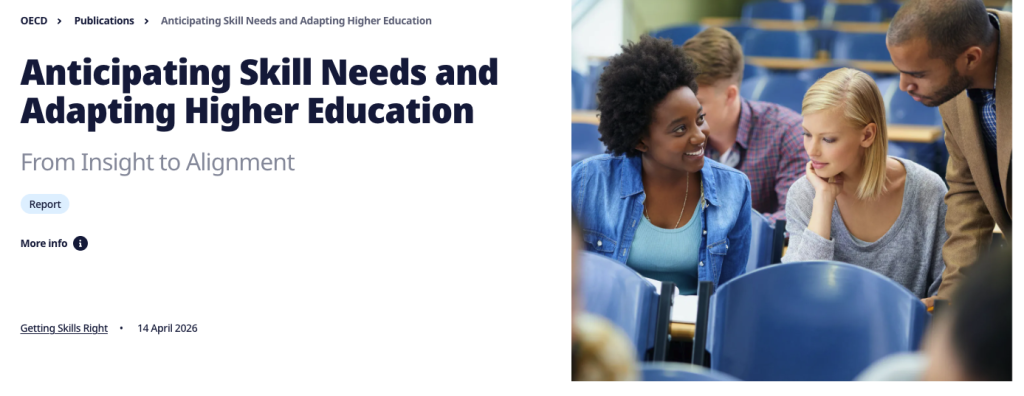
The report, Anticipating Skill Needs and Adapting Higher Education: From Insight to Alignment (OECD, 2026), is part of the OECD’s Getting Skills Right series. It reviews 17 national Skills Assessment and Anticipation (SAA) exercises across countries including Estonia, France, Ireland, the Netherlands, Singapore and Spain, mapping the different methodologies, governance models and data sources that countries use to understand and forecast skill needs.
The findings are revealing. Across the EU, 21% of workers are currently over-qualified for their roles, while significant shares report being either over-skilled or under-skilled. These mismatches carry real consequences — for productivity, for wages, and for individual wellbeing. Addressing them requires not just better data, but better systems for translating that data into action within higher education.
The report identifies a number of key lessons for building effective SAA systems:
—combining quantitative and qualitative methods
—engaging a wide range of stakeholders
—ensuring sustainable funding
— presenting results in ways that are accessible and actionable for policymakers, institutions and learners alike.
For those working in skills intelligence and higher education, the webinar also offered a timely reminder of how much progress has been made internationally — and how much opportunity remains to strengthen the connections between labour market intelligence and the design of higher education programmes.
The full report is available at the OECD website: Anticipating Skill Needs and Adapting Higher Education: From Insight to Alignment